
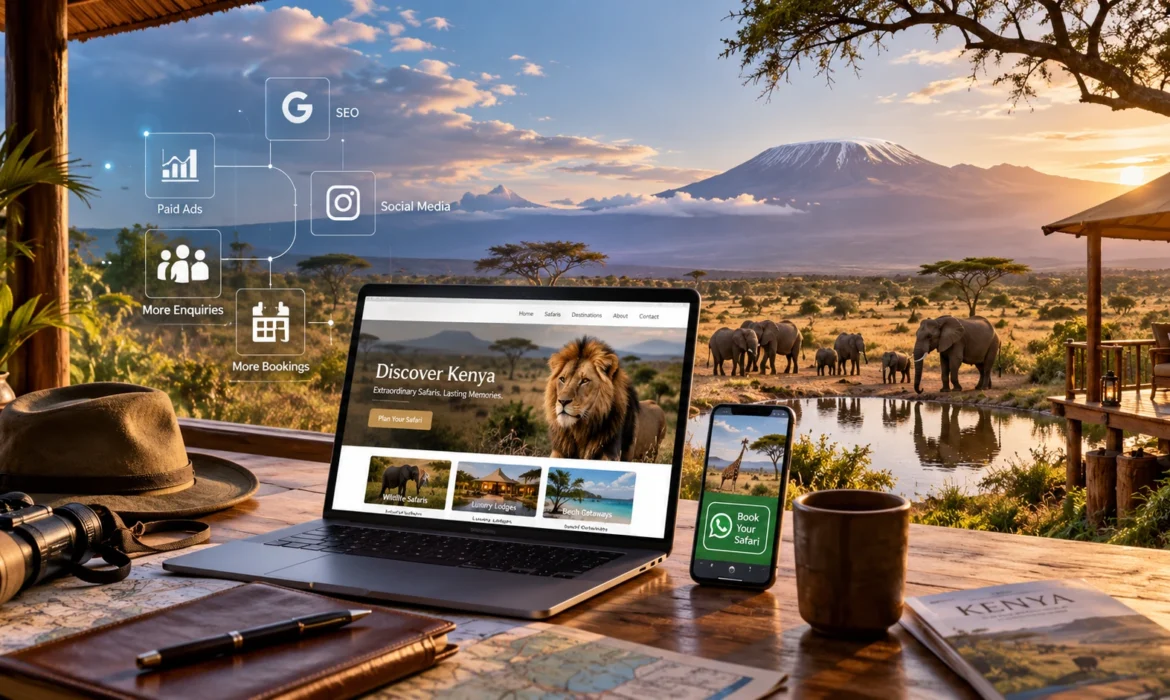
Digital marketing for safari companies is no longer simply about having a website or posting regularly on social media. For safari operators, tour companies, lodges, hotels and other hospitality businesses in Kenya, the real opportunity is to build a digital presence that attracts the right travellers, builds trust and turns interest into enquiries and bookings.
Kenya’s tourism industry is entering an increasingly competitive digital environment. According to Kenya’s Ministry of Tourism and Wildlife, international tourist arrivals increased from 1.65 million in FY 2022/23 to 2.42 million in FY 2024/25. Over the same period, tourism earnings increased from KSh 297.3 billion to KSh 458.2 billion.
These numbers point to an important opportunity for businesses operating in Kenya’s tourism and hospitality sector.
But there is a difference between being online and actually using digital channels to grow a business.
A safari company can have a beautiful website, thousands of followers on Instagram and Facebook, and still struggle to generate consistent enquiries.
The problem is often not the absence of digital channels.
It is the absence of a connected digital strategy.
The real opportunity is to build a system where the different parts of your digital presence work together:
Attract the right travellers → Build trust → Convert interest into enquiries → Turn enquiries into bookings → Measure the results → Improve continuously.
That is the foundation of effective digital marketing for safari companies and hospitality businesses.
Why Digital Marketing Matters for Safari and Hospitality Businesses
Travel decisions are rarely made after seeing one advertisement or visiting one website.
A potential traveller may discover Kenya through social media, search Google for destinations, compare safari operators, read reviews, visit several websites, look at photographs, check prices, ask questions on WhatsApp and eventually contact one or more companies.
The customer journey might look something like this:
Inspiration
“I want to visit Kenya.”
↓
Research
“What are the best places to go on safari?”
↓
Comparison
“Which safari company should I choose?”
↓
Validation
“Can I trust this company?”
↓
Planning
“How much will the trip cost?”
↓
Enquiry
“Can they create an itinerary for me?”
↓
Booking
“How do I confirm my trip?”
This is why a safari business should not think of its website, SEO, social media, advertising and reviews as completely separate activities.
They are different parts of the same customer journey.
Google’s guidance around helpful, people-first content also reinforces this principle: businesses should create content that genuinely helps their intended audience rather than producing material simply to attract search traffic.
For tourism businesses, that means answering the questions travellers actually have.
Kenya’s Tourism Industry Creates a Significant Digital Opportunity
Kenya has one of Africa’s most recognisable tourism brands.
The country has internationally known destinations including the Maasai Mara, Amboseli, Tsavo, Samburu, Lake Nakuru and the Kenyan coast.
But recognition of Kenya as a destination does not automatically mean an individual safari company or hotel will receive the booking.
Travellers still have to choose between competing businesses.
According to the Ministry of Tourism and Wildlife’s recent sector data, Kenya recorded approximately 2.42 million international tourist arrivals in FY 2024/25, with tourism earnings reaching KSh 458.2 billion.
That means there is a substantial market.
But it is also a competitive market.
The question for an individual business is therefore not simply:
“How do we get more tourists to Kenya?”
It is:
“How do we make sure the travellers interested in our destination discover, trust and choose us?”
That is where a strong digital presence becomes valuable.
A Website Is Not a Digital Strategy
One of the most common mistakes businesses make is treating the website as the end of their digital journey.
A website is important.
But having a website does not automatically mean people will find it.
And getting people to the website does not automatically mean they will enquire.
A successful tourism website needs to perform several jobs.
It needs to:
- Explain what the business offers
- Attract relevant visitors
- Communicate expertise
- Build credibility
- Answer important questions
- Showcase experiences
- Differentiate the business
- Make enquiries easy
- Work well on mobile devices
- Load efficiently
- Provide measurable data
Think about it this way.
A website is your digital storefront.
SEO helps people find the storefront.
Content gives them a reason to enter.
Reviews help them trust the business.
Good website design helps them understand what you offer.
WhatsApp, calls and enquiry forms give them a way to start a conversation.
Analytics tells you what happened.
Digital marketing connects all of these pieces.
The Digital Growth Framework for Safari Businesses
At Aquila Infotech, we see digital growth as a continuous cycle rather than a collection of isolated services.
The framework is:
ATTRACT → TRUST → CONVERT → MEASURE → IMPROVE
Attract
Help the right travellers discover your business.
This can happen through:
- Google Search
- SEO
- Google Business Profile
- Social media
- YouTube
- Travel content
- Paid advertising
- Referrals
- Online travel platforms
The goal isn’t simply to get more traffic.
It is to attract people who are genuinely interested in what you sell.
Trust
Once someone discovers your business, you need to give them reasons to believe you can deliver what you promise.
Trust can come from:
- Genuine customer reviews
- Real photographs
- Traveller experiences
- Guide profiles
- Destination expertise
- Company history
- Clear contact information
- Professional communication
- Transparent package information
- Relevant certifications and memberships
Don’t simply say that your company provides “unforgettable experiences.”
Show potential customers why they should believe you.
Convert
Once someone becomes interested, make the next step simple.
Give them clear options:
- Request an itinerary
- Get a quotation
- Plan a safari
- Talk to a safari specialist
- Send a WhatsApp message
- Call the business
- Make a booking
The objective isn’t necessarily to force someone to book immediately.
It is to remove unnecessary friction between interest and action.
Measure
You need to know whether your digital activities are producing business results.
Instead of only looking at followers and website visitors, track:
- Enquiries
- WhatsApp conversations
- Calls
- Quote requests
- Booking requests
- Qualified leads
- Confirmed bookings
- Revenue
- Cost per lead
- Cost per acquisition
Improve
Digital growth should never be considered finished.
Analyse the data.
Listen to customers.
Identify weaknesses.
Improve the website.
Create better content.
Refine your SEO.
Improve your advertising.
Strengthen your conversion process.
Then repeat the cycle.
SEO for Safari Companies Should Follow Search Intent
Search engine optimisation can be one of the most valuable long-term digital marketing investments for a safari business.
But SEO shouldn’t start with:
“What keyword can we rank for?”
It should start with:
“What is our potential customer trying to find?”
Consider the difference between these searches:
“Kenya safari”
“best time to visit Maasai Mara”
“3 day Maasai Mara safari”
“Kenya safari cost”
“private safari Kenya”
“Kenya family safari”
“Masai Mara safari from Nairobi”
These searches represent different stages of the decision-making process.
Someone searching for the best time to visit the Maasai Mara may still be researching.
Someone searching for the price of a three-day safari may be closer to making a purchase decision.
Someone searching for a safari company may already be comparing providers.
A strong SEO strategy recognises these differences.
Instead of trying to rank one page for everything, build a useful collection of pages that address different forms of search intent.
Build Content Around the Questions Travellers Actually Ask
A safari company’s blog should not exist simply because someone said:
“Every business needs a blog.”
Content should have a job.
For example, a safari company could create useful planning guides such as:
- How much does a Kenya safari cost?
- How many days do you need for a Kenya safari?
- What should you pack for a Kenya safari?
- What is the best time to visit Kenya?
- Is Kenya suitable for a family safari?
Destination guides could include:
- Complete Maasai Mara safari guide
- Amboseli National Park travel guide
- Tsavo East vs Tsavo West
- Samburu safari guide
- Lake Nakuru travel guide
Commercial content could cover:
- Best Kenya safari packages
- Private vs group safari
- Luxury vs budget safari
- Kenya honeymoon safari
- Kenya safari for families
And trust-focused content could include:
- Meet our safari guides
- How we plan your safari
- What happens after you make an enquiry?
- Why choose a local Kenyan safari company?
- How we support responsible tourism
This type of content can help a business become useful before the traveller is ready to buy.
It also provides opportunities to demonstrate genuine expertise.
For a safari company, that expertise already exists within the business.
Your guides have stories.
Your team knows destinations.
Your customers ask questions.
Your business has experience.
That knowledge should become part of your digital content.
Your Social Media Should Do More Than Generate Likes
Safari and hospitality businesses have a natural advantage on social media.
Wildlife is visual.
Landscapes are visual.
Hotels are visual.
Food is visual.
Beaches are visual.
Travel experiences are visual.
Platforms such as Instagram, Facebook, YouTube and TikTok can therefore play an important role in creating awareness and inspiration.
But likes should not be the final objective.
A beautiful photograph of a lion may attract attention.
A beautiful photograph accompanied by useful information about where the photograph was taken, what travellers can expect and how they can plan their visit creates something more valuable.
It informs.
It demonstrates expertise.
It tells a story.
And it gives the audience a reason to explore further.
The ideal journey might look like:
Instagram → Website → Reviews → WhatsApp → Itinerary → Booking
Social media becomes much more powerful when it is connected to the rest of the customer journey.
Your Online Reputation Is Part of Your Marketing
Imagine a traveller has found two safari companies.
Both offer similar itineraries at similar prices.
One has dozens of recent, detailed customer reviews.
The other has very few.
Which one would you feel more comfortable contacting?
Reviews are not merely a reputation-management issue.
They are part of the sales process.
Your digital presence should make it easy for potential customers to see evidence of real experiences.
That can include:
- Google reviews
- TripAdvisor reviews
- Customer testimonials
- Traveller photographs
- Video testimonials
- Guide profiles
- Customer stories
- Media coverage
- Relevant industry memberships
And don’t manufacture credibility.
Earn it.
Then make it visible.
Google Business Profile Deserves Attention
For businesses operating in tourism and hospitality, Google Business Profile can be an important part of the online presence.
Make sure your profile contains accurate information about:
- Business name
- Category
- Website
- Phone number
- Business description
- Photos
- Services
- Operating information
- Reviews
But don’t create the profile and forget about it.
Monitor reviews.
Respond appropriately.
Keep your information accurate.
Add useful photographs.
Make sure your website and other online profiles communicate consistent information.
Your Google Business Profile is another opportunity for someone to encounter your business during their research process.
WhatsApp Can Turn Interest Into Conversations
For many Kenyan businesses, WhatsApp is already a familiar communication channel.
For tourism businesses, it can be particularly useful.
A traveller may not be ready to complete a long booking form.
But they may be perfectly comfortable sending:
“Hi, I’m interested in a five-day Kenya safari in September. Can you help me plan it?”
That conversation can become the beginning of a booking.
The important thing is to design the journey properly.
For example:
Plan Your Safari
↓
WhatsApp conversation
↓
Understand traveller requirements
↓
Recommend an itinerary
↓
Send proposal
↓
Follow up
↓
Booking
The technology itself isn’t the strategy.
The strategy is the customer journey around it.
Paid Advertising Can Accelerate Demand
SEO is a long-term investment.
Paid advertising can help businesses access existing demand more quickly.
Depending on the business, opportunities may include:
- Google Ads
- Meta Ads
- YouTube advertising
- Remarketing
- Display campaigns
But advertising shouldn’t be used to compensate for a weak digital foundation.
If you send expensive advertising traffic to a slow website with unclear packages, poor trust signals and no obvious conversion path, you may simply be paying to expose weaknesses.
A better approach is:
Audience + Offer + Landing Page + Conversion Process + Tracking
Then measure the commercial result.
A useful example comes from Travelstart, which reported that changing its performance marketing approach from focusing primarily on booking volume toward booking value resulted in a 27% year-on-year increase in revenue, alongside increases in revenue per booking and ROI.
The broader lesson is valuable for tourism businesses:
Don’t optimise digital marketing simply for activity.
Optimise it for business value.
Website Performance Still Matters
Tourism websites often depend heavily on photography and video.
That creates a challenge.
Large images can make a website visually impressive but can also affect loading performance when they aren’t properly optimised.
Google’s Core Web Vitals provide specific measurements for loading performance, responsiveness and visual stability.
Google currently identifies these key targets:
- Largest Contentful Paint: 2.5 seconds or less
- Interaction to Next Paint: below 200 milliseconds
- Cumulative Layout Shift: below 0.1
For tourism websites, the answer isn’t to remove the photography that makes the site compelling.
The answer is to deliver it efficiently.
That may involve:
- Properly sized images
- Modern image formats
- Lazy loading
- Caching
- Optimised scripts
- Good hosting
- Efficient themes and plugins
- Mobile-first design
The goal should be:
Beautiful + Useful + Fast.
Don’t Make the Traveller Work Too Hard
One of the simplest ways to improve a tourism website is to look at it from the customer’s perspective.
Imagine you know nothing about the company.
Can you immediately answer:
What do they offer?
Where do they operate?
Who are they?
Why should I trust them?
How much might this cost?
What happens if I enquire?
How do I contact them?
What should I do next?
If the answer to these questions isn’t obvious, the website is making the customer work too hard.
Good digital marketing doesn’t simply bring people to a website.
It helps them make decisions once they arrive.
Build Destination Authority
One of the biggest opportunities for safari companies is to become a trusted source of information about the destinations they sell.
Instead of publishing only:
“Book our five-day Maasai Mara safari.”
Create an ecosystem of useful information around the destination.
For example:
- How to get to the Maasai Mara
- Best time to visit the Maasai Mara
- What animals can you see?
- How many days should you spend there?
- What should you pack?
- How much does a Maasai Mara safari cost?
- Where should first-time visitors stay?
- Maasai Mara vs Amboseli
- Photography tips for your safari
Now your business can potentially meet travellers much earlier in their journey.
You’re not simply asking:
“How do we sell our package?”
You’re asking:
“How can we become useful to someone planning this trip?”
That is a fundamentally different content strategy.
Your Digital Presence Must Match the Real Business
There is one principle that should sit underneath every tourism marketing strategy:
Your digital presence should accurately represent the business.
If you claim to provide personalised service, the enquiry process should feel personalised.
If you claim to know Kenya, your content should demonstrate genuine knowledge.
If you claim to care about sustainability, explain what you actually do.
If you claim to respond quickly, make sure someone responds quickly.
Digital marketing cannot permanently hide a poor customer experience.
Eventually, the traveller discovers the truth.
The strongest tourism brands therefore don’t treat marketing as something separate from operations.
The digital experience is part of the customer experience.
A Practical Six-Month Digital Growth Roadmap
You don’t have to implement everything at once.
A practical strategy can be built progressively.
Month 1: Build the Foundation
Focus on:
- Website audit
- Mobile experience
- Website performance
- Google Business Profile
- Google Analytics
- Google Search Console
- Conversion tracking
- Clear calls to action
- Trust signals
The objective:
Make sure the foundation works.
Months 2–3: Build Visibility
Develop:
- Destination pages
- Safari package pages
- Commercial landing pages
- SEO strategy
- Useful travel content
- Google Business Profile activity
- Social media content
The objective:
Get discovered by the right people.
Months 3–4: Improve Conversion
Focus on:
- Enquiry forms
- Calls to action
- Landing pages
- Itinerary requests
- Lead follow-up
- Response processes
The objective:
Turn interest into conversations.
Months 4–6: Accelerate Growth
Where appropriate, introduce:
- Google Ads
- Meta advertising
- Remarketing
- Email marketing
- YouTube
- Campaign-specific landing pages
- Partnerships
The objective:
Increase qualified demand.
Every Month: Measure and Improve
Ask:
What brought people to us?
Which pages generated enquiries?
Which content attracted qualified visitors?
Which campaigns generated leads?
Which leads became bookings?
What questions are customers asking?
Where are potential customers dropping out?
What should we improve next?
This is where digital marketing becomes a growth process rather than a collection of campaigns.
What Should Safari Businesses Actually Measure?
Vanity metrics can be useful for understanding awareness, but they shouldn’t become the entire measurement strategy.
A business might have:
50,000 followers
100,000 website visitors
1 million social impressions
and still have a disappointing sales pipeline.
Instead, think in layers.
Visibility
- Search impressions
- Organic traffic
- Search rankings
- Google Business Profile visibility
Engagement
- Engaged visitors
- Popular pages
- Returning visitors
- Content engagement
Conversion
- WhatsApp enquiries
- Calls
- Email enquiries
- Quote requests
- Booking requests
Business Results
- Qualified leads
- Confirmed bookings
- Revenue
- Cost per lead
- Cost per booking
- Return on advertising spend
The ultimate question is:
Which parts of our digital presence are helping generate actual business?
The Aquila Infotech Approach
At Aquila Infotech, we don’t believe a website should exist simply because a business needs to “have a website.”
And we don’t believe digital marketing should be reduced to posting on social media every day.
The bigger question is:
Does your digital presence help the right customers discover you, trust you, contact you and ultimately choose your business?
Our approach is built around five stages:
Attract
Help the right travellers discover your business through search, content, social media and other relevant digital channels.
Trust
Demonstrate expertise, experience and credibility through useful information, reviews and authentic customer experiences.
Convert
Make it simple for interested travellers to start a conversation, request an itinerary or make a booking.
Measure
Understand which activities are producing meaningful business results.
Improve
Use the information you collect to continuously improve the website, SEO, content, campaigns and customer journey.
The goal isn’t simply to make a safari or hospitality business look good online.
The goal is to make its digital presence work harder for the business.
Frequently Asked Questions
What is digital marketing for safari companies?
Digital marketing for safari companies involves using websites, search engines, SEO, social media, content, Google Business Profile, advertising, email and communication channels such as WhatsApp to attract potential travellers, build trust and generate enquiries or bookings.
How can a safari company get more bookings online?
A safari company can improve its online bookings by combining a strong website with SEO, useful destination content, positive reviews, clear safari packages, effective calls to action and simple enquiry channels such as WhatsApp. Paid advertising can then be used to accelerate qualified traffic where appropriate.
Does a safari company need SEO?
SEO can help safari companies appear when potential travellers search for destinations, safari packages, travel information and related services. It is particularly useful for businesses looking to build a sustainable source of organic visibility over time.
What should a safari website include?
A strong safari website should clearly explain the company’s services, destinations, safari packages, itineraries and booking process. It should also include photographs, reviews, company information, contact options and clear calls to action.
How can safari companies get more direct bookings?
Direct bookings can be supported by building search visibility, creating useful travel content, maintaining a strong online reputation, improving the website experience and making it easy for travellers to contact the business directly.
How long does SEO take for a safari company?
There is no guaranteed timeframe. SEO results depend on competition, website authority, technical performance, content quality, search intent and the specific keywords being targeted. SEO should generally be viewed as a long-term investment.
Should safari companies use Google Ads?
Google Ads can help businesses capture existing search demand quickly. However, advertising works best when the website, offer, landing page, conversion process and tracking are already strong.
Is social media enough for a safari company?
Social media can be an important part of tourism marketing, particularly for visual storytelling and inspiration. However, it shouldn’t replace a strong website, SEO, reputation management and a well-designed conversion process.
Your Digital Presence Should Work Like a Business Asset
The question for a safari or hospitality business should no longer be:
“Do we have a website?”
The better question is:
“Is our digital presence helping the right travellers discover us, trust us, contact us and ultimately book with us?”
Kenya’s tourism industry presents a significant opportunity.
But opportunity alone doesn’t create bookings.
Businesses need systems that connect visibility, trust, conversion and measurement.
That means:
Attract.
Build trust.
Convert.
Measure.
Improve.
A website is part of that system.
SEO is part of it.
Social media is part of it.
Reviews are part of it.
WhatsApp is part of it.
Advertising is part of it.
But the real value comes when all these pieces work together.
For safari and hospitality businesses in Kenya, the future of digital marketing isn’t simply about being everywhere.
It is about being useful, discoverable, credible and easy to do business with.
And that is the kind of digital presence that can become a genuine growth asset.
Ready to Turn Your Digital Presence Into a Growth Engine?
If you run a safari company, hotel, lodge, camp or hospitality business in Kenya, let’s identify where your digital presence can generate more enquiries and bookings.
Get Your Digital Growth Assessment
References
- Kenya Ministry of Tourism and Wildlife — Tourism Sub-sector Medium Term Expenditure Framework 2026/27–2028/29. Tourism arrivals and tourism earnings data for FY 2022/23–2024/25.
https://www.tourism.go.ke/ - Google Search Central — Creating Helpful, Reliable, People-First Content. Guidance on creating useful content for people, demonstrating experience and expertise, and avoiding search-engine-first content.
https://developers.google.com/search/docs/fundamentals/creating-helpful-content - Google Search Central — SEO Starter Guide. Guidance on helping search engines understand websites and creating useful, accessible content.
https://developers.google.com/search/docs/fundamentals/seo-starter-guide - Google Search Central — Core Web Vitals and Page Experience. Current guidance covering LCP, INP and CLS.
https://developers.google.com/search/docs/appearance/core-web-vitals - Google Travel — Understanding the Travel Customer Journey. Research and guidance on the different stages of the modern travel decision-making journey.
https://www.thinkwithgoogle.com/intl/en-emea/marketing-strategies/search/be-there-moments-new-travel-customer-journey/ - Think with Google — Travelstart Africa Performance Marketing Case Study. Case study examining the relationship between performance marketing, booking value, revenue and ROI.
https://www.thinkwithgoogle.com/intl/en-emea/marketing-strategies/data-and-measurement/performance-marketing-south-africa-ai-marketing-travelstart/ - Kenya Tourism Board — Tourism Marketing and Industry Partnerships. Information on collaborative tourism promotion and digital marketing initiatives.
https://ktb.go.ke/


