
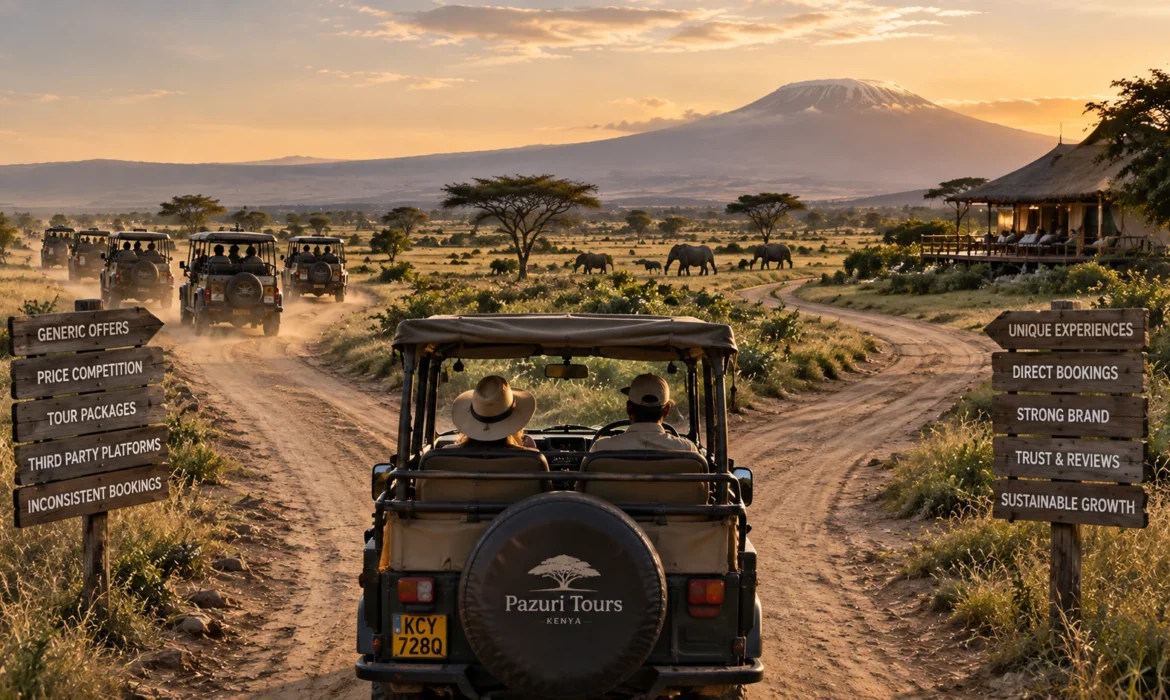
Introduction: Your Problem May Not Be a Lack of Marketing
If you’re wondering how to get more safari bookings, the first instinct is often to ask whether you need more advertising, more social media posts, a new website or a bigger marketing budget.
Sometimes you do.
But sometimes the problem is much deeper.
A safari business can have beautiful photography, experienced guides, attractive destinations, an impressive itinerary and an active social media presence—and still struggle to generate consistent enquiries and bookings.
That is because travellers don’t buy marketing channels.
They buy experiences they understand, trust and believe are worth paying for.
And before someone books a safari, there are several questions competing for their attention:
Why should I take this trip?
Why should I choose this experience?
Why should I choose this company?
Can I trust them?
Is the price justified?
What happens if something goes wrong?
What exactly am I getting?
How easy is it to ask a question or make a booking?
The digital presence of a safari or hospitality business has to answer those questions progressively.
That is why we believe the real growth journey is:
POSITION → PACKAGE → ATTRACT → TRUST → CONVERT → FOLLOW UP → MEASURE → GROW
This is the lens through which Aquila Infotech approaches digital growth for safari and hospitality businesses.
Kenya’s Tourism Opportunity Is Growing. So Is the Need to Compete Differently.
Kenya’s tourism sector has substantial economic momentum.
According to Kenya’s Ministry of Tourism and Wildlife, international tourist arrivals increased from 1.65 million in FY 2022/23 to 2.42 million in FY 2024/25. Tourism earnings increased from KSh297.3 billion to KSh458.2 billion over the same period. The Ministry also reported that average tourism spend increased from approximately KSh180,000 to KSh189,000.
Those numbers matter.
They tell us that the opportunity is significant.
But a growing tourism market does not automatically mean every individual safari company, hotel, lodge or camp will grow at the same rate.
Competition for attention remains intense.
And travellers have more ways to research, compare and evaluate businesses before they make a decision.
Google’s travel research has long highlighted how complex the travel decision journey can be, with travellers moving through different moments of inspiration, planning, booking and experiencing a trip.
The implication is straightforward:
Being online isn’t enough.
Your business has to be useful, credible and compelling at the moments when travellers are deciding what to do—and who to trust.
1. You’re Selling an Itinerary When You Should Be Selling an Experience
This is one of the most important problems we see in the way safari businesses can present themselves.
Consider:
5 Days Maasai Mara – Lake Nakuru – Amboseli
That’s an itinerary.
It tells me where I’m going and how long I’ll be there.
But it doesn’t necessarily tell me why I should want the experience.
Now consider:
A private Kenyan safari for first-time Africa travellers who want to experience the Big Five without rushing from one destination to another.
The second statement begins to sell a reason.
The distinction is subtle but commercially important.
Travellers don’t wake up thinking:
“I would like to purchase five days of vehicle-based transportation between three Kenyan destinations.”
They think:
“I want to see the Big Five.”
“I want to take my children on their first safari.”
“I want an unforgettable honeymoon.”
“I want to photograph wildlife.”
“I want to experience Kenya beyond the typical tourist route.”
The itinerary is the delivery mechanism.
The experience is the product in the customer’s mind.
How Aquila can help
Aquila can help safari and hospitality businesses examine how their experiences are positioned and presented online.
That can include:
- Customer and audience research
- Experience positioning
- Offer messaging
- Website copy
- Landing pages
- Experience-led content
- Campaign concepts
- Calls to action
The question isn’t simply:
“What safari do you sell?”
It is:
“What experience are you giving someone a reason to buy?”
2. Your Business Looks Too Similar to Everyone Else
Search for safari companies and you will encounter familiar language:
Unforgettable experiences.
Tailor-made safaris.
Discover Africa.
Explore Kenya.
Luxury safari experiences.
None of these statements is necessarily wrong.
The problem is that they are often interchangeable.
When ten businesses communicate almost identical promises, the traveller has difficulty understanding why one deserves preference over another.
And when meaningful differences disappear, price can become an increasingly convenient comparison point.
This is the fundamental difference between promotion and positioning.
Promotion asks:
How do we tell more people about ourselves?
Positioning asks:
Why should the right people choose us?
That second question comes first.
Aquila can help
We work from the principle:
Position before promotion.
That means identifying:
- Who the business is best suited to serve
- Which experiences it should own
- What makes those experiences distinctive
- What evidence supports the positioning
- How that difference should appear across the website, search, social media and campaigns
A strong brand doesn’t merely say:
“We are different.”
It makes the difference easy to understand.
3. Your Offers Are Generic and Easily Compared on Price
A safari package can become a commodity surprisingly quickly.
Imagine two companies offering:
4 nights Maasai Mara
5 nights Maasai Mara + Lake Nakuru
7 nights Kenya safari
If the traveller can’t see a meaningful difference, the comparison naturally moves toward price.
The answer isn’t always to reduce the price.
It may be to increase perceived value.
Consider the difference between:
Kenya Safari – 7 Days
and:
The First-Time Africa Safari — Seven Days of Big Five Wildlife, Expert Guiding and Kenya’s Most Iconic Landscapes
The second creates a proposition.
It gives the customer something to identify with.
That could lead to entirely different experience categories:
- First Safari in Africa
- Family Safari Adventure
- Luxury Big Five Escape
- Kenya Honeymoon Safari
- Photography Safari
- Conservation Safari
- Slow Safari
- Safari and Beach Escape
- Cultural Immersion Journey
- Private Anniversary Safari
The objective isn’t to invent fancy names for ordinary packages.
It is to ask:
Can the experience itself become part of the reason someone chooses the business?
4. You May Be Getting Website Visitors Without Getting Enough Enquiries
Traffic is useful.
But traffic is not the final business objective.
A website can receive visitors and still perform poorly commercially.
A traveller arrives.
They look around.
They can’t immediately understand what makes the company different.
They don’t see enough evidence.
The packages are difficult to compare.
The call to action is weak.
WhatsApp is difficult to find.
The enquiry form asks for too much information.
There is no compelling reason to act now.
So they leave.
The problem wasn’t necessarily traffic.
It was conversion.
A strong safari website should help answer:
Where can I go?
What can I experience?
Who is this for?
Why this company?
What does it cost or what determines the cost?
Can I trust them?
What happens next?
How do I enquire?
How Aquila can help
Our approach to website development should begin with the business objective—not the homepage design.
We can examine:
- Value proposition
- Information architecture
- Experience pages
- Destination pages
- Calls to action
- Enquiry forms
- WhatsApp journeys
- Trust signals
- Mobile experience
- Page speed
- Conversion paths
- Analytics and tracking
The goal isn’t simply:
“Build a beautiful website.”
It is:
Build a website that makes choosing the business easier.
5. Your Website May Be Talking Too Much About You
One of the easiest mistakes in tourism marketing is making the company the main character.
For example:
“We are a leading tour operator with 15 years of experience…”
That information may matter.
But a traveller arriving on the site may actually be asking:
“Can you help me plan the trip I’m dreaming about?”
Compare:
“We are a leading Kenyan tour operator.”
with:
“Planning your first Kenyan safari? Here’s how to choose the right parks, how many days you need and what you can realistically expect to spend.”
The second immediately addresses the customer’s situation.
This is what useful content does.
Google’s current guidance explicitly encourages content that demonstrates first-hand expertise, provides substantial value and leaves the reader feeling that they have learned enough to accomplish their goal. Google also recommends being clear about who created the content, how it was created and why it exists.
For a safari company, that means turning destination knowledge into something genuinely useful.
6. You’re Not Visible When Travellers Are Searching
A beautiful website is of limited value if the people looking for your services cannot find it.
This is where SEO for safari companies becomes strategic rather than technical.
There is a significant difference between being visible for:
“Maasai Mara”
and being visible for searches with stronger commercial intent such as:
“luxury Maasai Mara safari”
“family safari Kenya”
“Kenya safari and Zanzibar package”
“Maasai Mara safari from Nairobi”
The exact search landscape needs to be researched rather than guessed.
But the principle is important:
Build visibility around the problems, destinations, experiences and decisions your customers actually search for.
Google’s Search Essentials recommends using words that people would use to find the content and placing them in prominent, descriptive locations such as the title, main heading, alt text and link text.
Rank Math similarly recommends choosing focus keywords based on search volume, competition and the site’s authority, then using them naturally in important areas such as the title, URL, headings, introduction and content. It explicitly warns against keyword stuffing.
How Aquila can help
Our SEO work can include:
- Search intent research
- Keyword research
- Destination strategy
- Experience-page strategy
- Technical SEO
- On-page optimisation
- Internal linking
- Content strategy
- Search Console analysis
- Local search optimisation
The objective isn’t to rank for the largest number of keywords.
It is to become discoverable for the searches that matter commercially.
7. Your Social Media May Be Getting Attention Without Creating Demand
Safari businesses have an enormous visual advantage.
Wildlife.
Landscapes.
Lodges.
Food.
People.
Culture.
Adventure.
Sunsets.
But beautiful content alone doesn’t create a complete marketing system.
An elephant photograph can generate thousands of views.
The strategic question is:
What does that viewer do next?
A stronger content strategy moves beyond:
“Good morning from the Maasai Mara.”
toward:
“Thinking about your first safari? Here’s what actually happens on a typical game-drive morning—and why choosing the right guide matters.”
Now the content educates.
It builds expertise.
It reduces uncertainty.
And it creates a reason to continue the journey.
Google’s current guidance also emphasises creating unique, non-commodity content rather than simply recycling information that could easily be produced by anyone—or by an AI system.
That is particularly important in tourism.
Your experience is your content advantage.
8. You’re Showing Destinations Instead of Showing What the Traveller Will Experience
This is related to the previous problem, but it deserves its own attention.
Don’t simply show:
Maasai Mara.
Show what it feels like to wake up before sunrise, leave camp with an experienced guide and watch the landscape change as the morning begins.
Don’t just show:
A safari vehicle.
Show what having an experienced guide beside you changes.
Don’t simply show:
A lodge.
Show what the evening feels like after a long game drive.
Don’t simply show:
A beach.
Show the experience of finishing a safari and moving from wildlife to the Indian Ocean.
The shift is:
Destination marketing → Experience marketing.
That is where businesses can begin building more distinctive propositions.
9. Travellers Don’t Have Enough Reasons to Trust You
A safari can be a significant financial and emotional commitment.
The traveller may be booking from another country, communicating remotely and entrusting a business with a major holiday.
That creates a trust gap.
Your website should therefore answer more than:
“What do you sell?”
It should answer:
“Why should I trust you?”
Useful trust signals can include:
- Genuine customer reviews
- Detailed testimonials
- Traveller stories
- Real trip photography
- Guide profiles
- Company history
- Relevant certifications
- Clear contact information
- Transparent booking processes
- Clear payment information
- Safety information
- Frequently asked questions
- User-generated content
- Relevant media coverage
- Partnerships and affiliations
This isn’t about adding badges simply because they look impressive.
Every trust signal should help reduce a genuine customer concern.
Aquila’s role
We call this a digital trust architecture.
Trust should not live on one testimonials page.
It should be distributed throughout the customer journey.
10. Your Google Business Profile May Be an Untapped Asset
For businesses serving travellers locally, Google Business Profile can contribute to discovery and credibility.
It can help prospective customers see:
- Business information
- Reviews
- Photos
- Location
- Contact options
- Updates and other profile information
But many businesses treat the profile as something they create once and forget.
That misses the bigger opportunity.
Your Google presence should support the same positioning as your website.
If your website communicates premium private safari experiences while your Google profile is incomplete, poorly maintained or filled with inconsistent information, the overall customer experience suffers.
Google’s current guidance also specifically recommends keeping Business Profile information up to date as part of the fundamentals relevant to its AI-powered Search experiences.
11. You’re Generating Enquiries but Losing Potential Customers
This is one of the most overlooked parts of digital marketing.
Suppose a business generates enquiries.
What happens next?
Does someone respond quickly?
Is the traveller properly qualified?
Does the company understand what they actually want?
Is the proposal personalised?
Does someone follow up?
What happens if the traveller says:
“We’re still comparing options.”
What happens if they say:
“Your price is higher than another company.”
What happens if they disappear?
Marketing doesn’t end when the enquiry arrives.
That is when the sales process begins.
A stronger journey looks something like:
Enquiry
↓
Qualification
↓
Conversation
↓
Personalised recommendation
↓
Proposal
↓
Follow-up
↓
Objection handling
↓
Booking
How Aquila can help
Depending on the business, that can involve:
- Better enquiry forms
- WhatsApp conversion journeys
- CRM processes
- Automated follow-up
- Email sequences
- Lead tracking
- Conversion tracking
- Sales pipeline visibility
- Better proposal journeys
Generating leads is only half the job.
The other half is turning the right leads into customers.
12. You’re Depending Too Heavily on Intermediaries
Online travel agencies, agents and other intermediaries can be valuable distribution partners.
The issue is not that they exist.
The strategic question is:
How much demand does your own brand generate and own?
A healthy digital strategy can help build assets that belong to the business:
- Website traffic
- Search visibility
- Brand demand
- Email contacts
- Customer reviews
- Customer relationships
- Repeat bookings
- Referrals
- Direct enquiries
The goal isn’t necessarily to eliminate third parties.
It is to make sure the business is also building its own demand engine.
13. You’re Competing on Price Because Your Value Isn’t Clear Enough
If two businesses look almost identical, price becomes an easy comparison.
But imagine a traveller sees:
Option A:
“6-day Kenya safari.”
and:
Option B:
“Private six-day Big Five safari designed for first-time Africa travellers, with an experienced private guide, flexible game-drive schedule and carefully selected small properties.”
Now the conversation changes.
The second proposition gives the traveller more dimensions on which to evaluate value.
This doesn’t mean every business should become expensive or luxury.
It means:
Value needs to be communicated before price is evaluated.
Aquila can help businesses examine:
- Experience design
- Packaging
- Messaging
- Proof
- Positioning
- Customer segmentation
- Website presentation
- Campaign communication
Before asking:
“How much should we discount?”
Ask:
“Why isn’t the customer seeing enough value?”
14. You’re Marketing to “Tourists”
There is no single “tourist”.
A honeymoon couple has different motivations from a family travelling with three children.
A wildlife photographer is different from a first-time Africa traveller.
A luxury traveller is different from a budget traveller.
A domestic Kenyan traveller may have completely different considerations from an overseas visitor.
That means a generic message such as:
“Book your unforgettable African adventure.”
can struggle to speak deeply to anyone.
Instead:
Audience → Motivation → Experience → Message → Channel → Offer → CTA
For example:
Family traveller
→ Wants meaningful time together and manageable logistics
→ Family safari experience
→ “A first safari your children will talk about for years”
→ Search, social, content, referrals
→ Family-focused itinerary
→ “Plan Your Family Safari”
The more precisely you understand the customer, the easier it becomes to build relevant marketing.
15. You’re Talking About Yourself Instead of Telling Customer Stories
Tourism is fundamentally experiential.
That gives businesses an extraordinary storytelling opportunity.
Instead of constantly saying:
“We provide exceptional service.”
Tell the story of an actual experience.
Instead of:
“Our guides are experienced.”
Introduce a guide.
Instead of:
“Our safaris are personalised.”
Show how a real itinerary changed based on a traveller’s interests.
Instead of:
“We create unforgettable memories.”
Tell us about the moment a family saw their first elephant together.
The customer should frequently become the hero of the story.
Your company becomes the guide that helps make the experience possible.
16. Your Digital Channels Are Operating in Silos
This may be the biggest underlying problem of all.
The website does one thing.
Instagram does another.
Facebook does another.
SEO is handled separately.
Google Business Profile is forgotten.
WhatsApp lives on someone’s phone.
Reviews are collected inconsistently.
Advertising sends people to generic pages.
Analytics measures traffic but not revenue.
There is no unified customer journey.
That is not really a channel problem.
It is a systems problem.
A stronger digital ecosystem looks more like this:
Google / Social / Referral
↓
Useful content
↓
Experience-led landing page
↓
Positioning + proof
↓
Website
↓
WhatsApp / enquiry
↓
Sales follow-up
↓
Booking
↓
Customer experience
↓
Review
↓
Referral / repeat business
This is why we don’t believe digital marketing should be reduced to individual services.
The channels have to work together.
17. You’re Measuring Marketing Activity Instead of Business Results
Followers are useful.
Reach is useful.
Impressions are useful.
But they aren’t the same thing as business growth.
A safari business should eventually want to understand metrics such as:
Visibility
- Organic impressions
- Search visibility
- Relevant keyword rankings
- Google Business Profile visibility
- Referral traffic
Engagement
- Engaged website sessions
- Experience-page engagement
- Content interactions
- WhatsApp starts
- Enquiry starts
Conversion
- Enquiries
- Qualified enquiries
- Enquiry-to-booking rate
- Website conversion rate
- Cost per qualified enquiry
- Booking conversion rate
Commercial performance
- Direct bookings
- Booking value
- Revenue by channel
- Average booking value
- Repeat customers
- Referral bookings
- Return on advertising spend where applicable
A useful example comes from Google’s case study of African online travel platform Travelstart.
After shifting its performance-marketing focus from booking volume toward booking value, Travelstart reported a 27% year-on-year revenue increase, a 50% increase in revenue per booking and a 12% increase in ROI.
That does not mean a safari company should copy Travelstart’s tactics.
It illustrates a more important principle:
A booking is not simply a number. It has economic value.
Marketing decisions should eventually connect to that value.
18. Sometimes Marketing Isn’t the Problem. The Offer Is.
This is where many agencies get it wrong.
If bookings are declining, the immediate recommendation is often:
Run more ads.
But what if the offer isn’t compelling?
What if the website is simply exposing a weak proposition to more people?
More traffic won’t solve that.
More impressions won’t solve it.
More followers won’t solve it.
Sometimes the sequence needs to be:
Business
↓
Customer
↓
Experience
↓
Offer
↓
Positioning
↓
Digital presence
↓
Promotion
That’s fundamentally different from:
Website → SEO → Facebook Ads
The first approach starts with the business.
The second starts with marketing channels.
We believe the first is the better place to begin.
19. Your Website Performance May Be Quietly Working Against You
A safari website has an obvious challenge: visual content matters.
High-quality photography and video can make the experience tangible.
But poorly optimised media can also make a website frustrating to use.
Google recommends achieving good Core Web Vitals as part of providing a strong user experience. Its current thresholds include:
- LCP: within 2.5 seconds
- INP: below 200 milliseconds
- CLS: below 0.1
Google also stresses that Core Web Vitals are only part of the broader page experience and that achieving perfect scores does not guarantee top rankings.
For a tourism website, performance matters for another reason:
People are trying to imagine a holiday.
Don’t make them wait for the experience to load.
Aquila can help
That can involve:
- Image optimisation
- Mobile optimisation
- Caching
- Technical SEO
- Hosting configuration
- Core Web Vitals
- Performance monitoring
- Conversion-focused design
The objective isn’t a perfect score for its own sake.
It’s a website that loads quickly, communicates clearly and makes the next step easy.
20. You’re Creating Content for Google Instead of Creating Something Travellers Actually Want
This is an increasingly important distinction.
Google’s latest guidance is very clear: content should be created primarily for people, not primarily to manipulate rankings. Google specifically asks whether content provides original research or analysis, substantial value, first-hand expertise and information beyond the obvious.
Its latest guidance on AI-powered Search makes the same point.
There is no secret “AI SEO” trick.
Google says the same fundamental SEO practices continue to apply to AI Overviews and AI Mode. It emphasises unique, valuable, non-commodity content, clear organisation, high-quality images and content grounded in genuine expertise.
For safari businesses, that creates an opportunity.
You have access to something generic content farms don’t:
real experiences.
Real guides.
Real destinations.
Real travellers.
Real questions.
Real mistakes.
Real seasonal knowledge.
Real photographs.
Real stories.
Real expertise.
That is what your content should capture.
The Bigger Problem: You’re Treating Digital Marketing as a Collection of Services
This is where everything comes together.
A safari company doesn’t need:
as an isolated activity.
It needs to be discoverable.
It doesn’t need:
Social media
simply to have something to post.
It needs to build awareness, trust and desire.
It doesn’t need:
because every business is supposed to have one.
It needs a digital destination where travellers can understand, evaluate and enquire.
It doesn’t need:
More leads
if nobody follows them up.
It needs a system that turns qualified enquiries into bookings.
And it doesn’t need:
More analytics dashboards
if nobody uses the data to make better decisions.
It needs measurement connected to commercial outcomes.
That is the difference between doing digital marketing and building a digital growth system.
How Aquila Infotech Helps Safari & Hospitality Businesses
At Aquila Infotech, we don’t want to be another agency telling safari businesses to post more often or spend more money on advertising.
Our approach starts with a different question:
What is stopping the right traveller from choosing you?
We examine the journey from both sides.
From the business side:
- What are you trying to sell?
- Who is it really for?
- What makes it valuable?
- What makes it different?
- Where does your revenue come from?
- Which channels currently produce customers?
And from the traveller side:
- What are they searching for?
- What are they comparing?
- What concerns them?
- What convinces them?
- What makes them trust one business over another?
- What makes them enquire?
- What stops them from booking?
From there, we can build the digital system around the answers.
1. Position
Clarify what makes your business worth choosing.
2. Package
Turn itineraries and services into compelling experiences and offers.
3. Build
Create or improve the website and digital infrastructure.
4. Attract
Use SEO, content, social media and paid campaigns to reach relevant audiences.
5. Build Trust
Strengthen reviews, proof, stories, expertise and reputation.
6. Convert
Improve landing pages, calls to action, WhatsApp, forms and enquiry journeys.
7. Follow Up
Help create systems that turn enquiries into customers.
8. Measure
Connect digital activity to meaningful business outcomes.
9. Improve
Use data, customer feedback and market changes to keep improving.
The Aquila Safari & Hospitality Growth Framework
We see the process as:
POSITION
Give travellers a reason to choose you.
↓
PACKAGE
Turn what you sell into experiences people want.
↓
ATTRACT
Become visible when the right people are searching and exploring.
↓
TRUST
Give them enough evidence to believe you are the right choice.
↓
CONVERT
Make it easy to enquire, communicate and take the next step.
↓
FOLLOW UP
Turn opportunities into customers.
↓
MEASURE
Understand what is actually producing business.
↓
GROW
Double down on what works.
This is the thinking behind our move toward working more deeply with safari and hospitality businesses.
Why We Believe This Requires More Than “Digital Marketing”
A safari isn’t a commodity.
It is an experience.
For many travellers, it represents significant money, planning and emotional investment.
That means the marketing has to understand more than algorithms.
It has to understand:
People.
Experiences.
Trust.
Value.
Positioning.
Search behaviour.
Sales.
Conversion.
Business economics.
That’s why our approach doesn’t begin with:
“Which social media platform should we post on?”
It begins with:
“Why should the right traveller choose this business?”
Everything else follows from that answer.
Is Your Safari Business Ready to Be Chosen?
Here’s the uncomfortable question:
If a traveller compared your business with five of your competitors today, would they immediately understand why they should choose you?
If the answer isn’t an emphatic yes, there is work to do.
Maybe the problem is your positioning.
Maybe your experiences aren’t packaged compellingly.
Maybe your website isn’t converting.
Maybe you’re invisible for important searches.
Maybe your content is generating attention but not demand.
Maybe travellers don’t see enough proof.
Maybe enquiries are being lost during follow-up.
Maybe you’re measuring likes instead of revenue.
Or perhaps the real problem is something else entirely.
That’s exactly what needs to be diagnosed.
Get Your Safari Business Digital Growth Assessment
You don’t need another agency promising more posts, more followers or more traffic.
You need someone to look at the whole customer journey and identify what is preventing more of the right travellers from choosing your business.
Aquila Infotech helps safari companies, tour operators, lodges, camps, hotels and other hospitality businesses examine the digital growth system behind their business—from positioning and experience packaging to websites, SEO, content, reputation, enquiries, conversion and measurement.
Because getting more traffic isn’t the goal.
Getting more of the right travellers to choose you is.
Get Your Safari Business Digital Growth Assessment →
We’ll look at your digital presence from the traveller’s perspective and identify the opportunities that could have the greatest impact on visibility, trust, enquiries and bookings.
Your next booking may not require more marketing.
It may require better marketing.
And sometimes, it starts by fixing the thing you didn’t realise was holding you back.
Frequently Asked Questions
How can I get more safari bookings?
Start by examining the entire customer journey rather than immediately increasing advertising spend. Review your positioning, offers, website conversion, search visibility, trust signals, enquiry process and follow-up. The goal is to attract the right travellers and make it easier for them to choose and contact you.
How can a safari company differentiate itself from competitors?
Start with the customer rather than the competitor. Identify a specific audience, understand its motivations and build an experience and proposition around those motivations. Strong differentiation should be visible in the offer, messaging, website, content and customer experience—not just in a slogan.
Should safari companies compete on price?
Not necessarily. If businesses appear interchangeable, price becomes an easy comparison. Strengthening experience design, positioning, proof, service and communication can increase perceived value and give travellers more meaningful reasons to choose a business.
Does SEO work for safari companies?
SEO can help safari companies become discoverable when travellers search for destinations, experiences, questions and services related to their business. The most useful strategy is usually based on search intent rather than simply trying to rank for broad destination names.
Why does my safari website get visitors but few enquiries?
Possible causes include unclear positioning, weak calls to action, insufficient trust signals, confusing offers, poor mobile experience, slow performance or a difficult enquiry process. Analytics and user-journey analysis can help identify where visitors are dropping out.
How important are reviews for safari businesses?
Reviews can contribute to trust and help prospective customers evaluate a business. They should be genuine, easy to understand and supported by other evidence such as traveller stories, real photographs, guide profiles and clear business information.
Should safari businesses use WhatsApp?
WhatsApp can be useful when it fits the customer journey and provides a convenient way for prospective travellers to ask questions. The important consideration is not simply adding a WhatsApp button, but building a process for responding to, qualifying and following up with enquiries.
What should safari companies measure?
Beyond followers and impressions, businesses should consider measuring qualified enquiries, enquiry-to-booking conversion, direct bookings, booking value, revenue by channel, website conversion rates, cost per qualified enquiry and repeat or referral business.
Conclusion
Kenya’s tourism industry is growing. The Ministry of Tourism and Wildlife reported 2.42 million international arrivals and KSh458.2 billion in tourism earnings in FY2024/25.
That creates opportunity.
But opportunity doesn’t distribute itself evenly.
The safari and hospitality businesses most likely to benefit will not necessarily be the ones that post the most, spend the most on ads or have the biggest follower count.
They will be the businesses that understand why their customers choose, compare, trust and ultimately buy.
They will turn itineraries into experiences.
They will turn experiences into compelling offers.
They will make those offers discoverable.
They will build trust.
They will make enquiries easy.
They will follow up properly.
And they will measure what actually contributes to growth.
That is the opportunity for digital marketing in safari and hospitality.
Not simply to get more people to see your business.
But to make your business easier to discover, easier to trust, easier to choose and easier to book.
That is the kind of digital growth Aquila Infotech wants to help build.
References
- Kenya Ministry of Tourism and Wildlife — Tourism Sub-Sector Medium Term Expenditure Framework 2026/27–2028/29 — tourism arrivals, earnings and sector performance. Kenya Ministry of Tourism and Wildlife — Tourism Sub-Sector MTEF


